
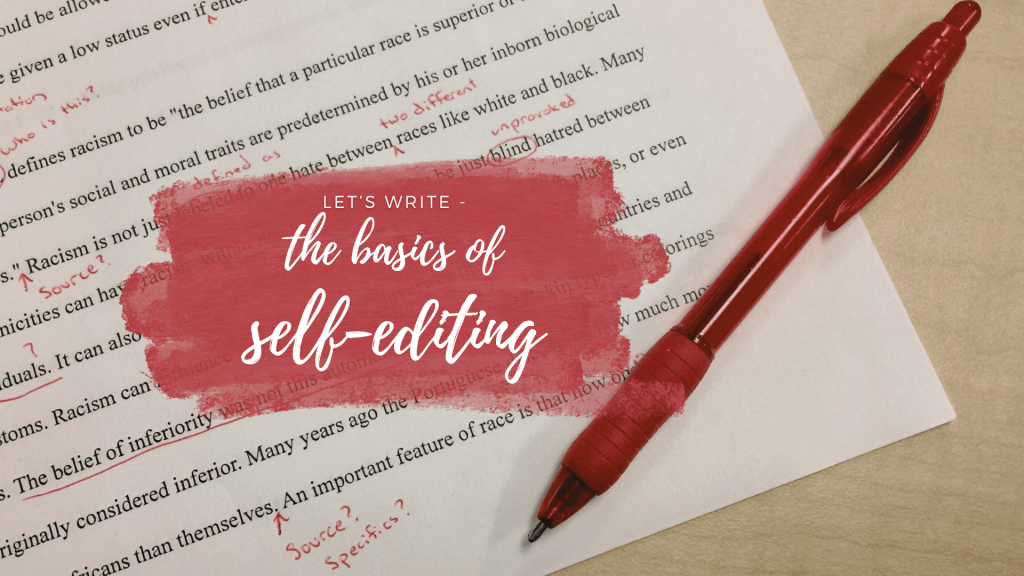
The editing process has always intrigued me—a fascination that most authors don’t share, I know. But it still blows my mind how applying grammatical and stylistic rules can take a manuscript from so-so to great, and that with minimal effort.
And the best part is that self-editing is an easy skill all authors can learn and nurture.
Why Self-Edit?
Besides honing our craft, creating our best work, and not alienating readers?
Writers aren’t made of money. Sure, the Kings and Rowlings of the world have it pretty good, but most of us still have to turn those pennies.
Meanwhile, professional editors often charge by the word.
Self-editing before the editor picks up their red pen usually lowers word counts, which means more cash in our back pockets. We’ll also make an editor’s day.
Additionally, those manuscripts that are more polished than the others in an agent’s inbox are more likely to keep their attention, increasing their chances of scoring a sweet publishing deal.
Does Self-Editing Cut Out Editors?
No.
All books should be edited before they’re released in the wild.
Readers expect a certain level of quality from traditional publishers, so the bigwigs don’t (usually) skimp where it counts—tightening the story and rooting out grammatical gremlins.
Indie authors must do the same. Readers judge us more harshly than traditionally published authors because too many indie books never receive the editing love they need. And all indies get a bad rep.
Even if we can’t afford professional editors, there are scores of indie editors out there, ready to help.
But, if you decide not to have your book edited for whatever reason, a bit of self-editing can still go a long way.
Also, beta readers. Having another person read the manuscript before publishing makes a huge difference. (Read more in my article, Let’s Talk About Alpha & Beta Readers.) Some authors prefer to do a mini self-edit before sending the manuscript to the beta team. Others don’t edit at all until they’ve heard from their beta readers.
I do a combination of both. The alpha team is clued in on the entire story, as it is in my head. Major spoilers here. They read and brainstorm as I write, and give immediate feedback. Once I’ve heard their thoughts, I self-edit, then send the manuscript to the beta team, and once I have their feedback I self-edit again before sending anything to my editor.
The Four Steps of Editing
Editing can be broken up into four main steps.
- The structural edit (also called developmental edit)
- Refining and reviewing
- The line edit
- Proofreading
1) Structural Editing
This is the step where we search for elements that damage the logic of our story, elements that hinder us from effectively telling the story, and elements that might confuse the reader.
Specifically:
- Plot and setting
- Characters
- Flow and pace
- Conflict and resolution
- Style
- Voice
Alpha and beta readers are often most useful during the structural edit. As readers, they instinctively pick up what ‘breaks’ the story. And that’s why it’s so important for writers to read and offer their services as beta readers—we learn how to identify problematic elements in stories.
2) Refining and Reviewing
During this step, we reread the manuscript to make sure we didn’t miss any of the changes from the previous step, and add or subtract from the text where needed. We work at a paragraph level, strengthening the overall story.
Of course we can and should fix grammatical and stylistic errors as they pop up—if it doesn’t ruin our creative flow. Some of my author friends lose their focus on the bigger picture stuff if they worry about grammar too early in the editing process. Other authors (like me) can’t not fix the grammatical and stylistic issues we find immediately. We all write differently! So, do what works for you.
Look out for:
- Consistency (in plot, characterisation, tense, and style)
- Voice
- Eliminating unnecessary wordiness
- Alternatives to cliches
- Removing intensifiers, redundancies, and weasel words
- Stronger verbs
- Turning passive voice sentences to active voice
Once we’ve completed this step, it’s a good idea to take a break. Distance from something we’re *SO PASSIONATE ABOUT* is the absolute worst, I know. But I promise it’ll be worth it when we come back with fresh eyes. I use this break to send the manuscript to the beta team or my editor.
3) The Line Edit
Grammar fanatics unite! With our dictionaries and grammar bibles at the ready, we edit the story on a sentence level.
Since the list of typical grammatical errors is longer than Gandalf’s beard, I’m not going into detail about any of that now. I will, however, do a follow-up post with a few common errors I constantly find in my writing.
Look out for:
- Word choices
- Flow and rhythm of sentences
- Ensure metaphors and poetic writing pack a punch
4) Proofreading
Proofreading is line editing’s big brother.
The proofreader’s job is to catch all the die-hard grammatical, spelling, and punctuation gremlins that stubbornly squeeze through the cracks and make it into the final, to-be-published draft of a manuscript.
Additionally, proofreading usually takes place after our manuscripts have been formatted for print because glitches in the formatting process can cause sentences to be broken off in weird places, punctuation to disappear, or italics to straighten. Proofreaders identify those problems so that the published work has the fewest possible issues.
During this step, we (or the proofreader) should also check for consistency of style. If a word was hyphenated the last two times but lacks a hyphen in the next two instances, a common spelling must be found and applied throughout the manuscript. The same with capitalisation, spelling of made-up words or names, tenses, UK vs US English, etc.
And that brings us to the end of this overview post. During the next few weeks, we’ll go in-depth into the structural edit, so be sure to check that out.
Until next time.
Yolandie




 Yolandie Horak
Leave a reply to Let’s Write – The Basics of Self-Editing: Common Mistakes – Yolandie Horak Cancel reply